

You Are The Man!
Introduction to the Collapse of the King

To the Choirmaster.
A Psalm of David, when Nathan the prophet went to him, after he had gone in to Bathsheba.
—the rubric before Psalm 51
We will begin our consideration of Psalm 51 tomorrow, but today we can say a few things about the “rubrics” or the “notes” for the choirmaster. And we can also make sure we have the storyline down before we begin.

To The Choirmaster
Psalm 51 has a short rubric preceding it—a sort of stage direction. Do you see the note to the choirmaster? Doesn’t that strike you as odd that a very personal confession of the King of all Israel would be sung openly by a choir, presumably in a public setting!
Support the work of The Anglican by becoming a Paid Subscriber for only $60/year or $10/month. You will gain access to the entire series and everything else.
Go here to make it happen.
This is strange to me, but consistent with the biblical story. Most books and biographies try to hide their hero’s flaws or present the subject with some sort of nuance. But not here. David’s sin is to be sung aloud by a choir! (Imagine a musical composed about the worst moments in your life!)
But the point is clear: the Bible will always tell the truth.
But then the rubric continues: “A Psalm of David, when Nathan the prophet went to him, after he had gone in to Bathsheba.”
That single line carries more weight than many chapters of Scripture. It names the moment when a private sin became a public reckoning, when the most powerful man in Israel was finally forced to see himself clearly.
The language itself presses the point.
David went into Bathsheba. The phrase is discreet, almost understated, but its meaning is clear. David went into her personal space, into her sovereign territory, and into her life and body. The word implies union. It also implies a violation. Power crossed a boundary and took what did not belong to it.
Then the same word is turned back on David.
Nathan the prophet went into him. What David entered in secret, Nathan’s truth now enters without invitation. The king who crossed a very personal boundary now has his own interior life crossed. The king who assumed control and violated a young woman now finds himself entered, examined, and undone. Violated, too.
It is the same verb.
The same motion.
Two very different acts.
One takes.
The other exposes.
One conceals.
The other brings into the light.
That is the turning point. Not when the sin was committed. Not even when it was concealed. But when truth was allowed to go in.
The Sordid Details of the Story
David Took What Was Not His
As we saw in yesterday’s post, David’s fall did not begin with Bathsheba. It began earlier, more subtly, and far more familiarly.
“In the spring of the year, the time when kings go out to battle,” the biblical narrative tells us, David stayed home.1
That detail matters. David was not where he should have been. The army was fighting. The king was resting. Responsibility had been deferred, vigilance relaxed. The moral failure that followed was not sudden; given the king's relaxed, lazy nature, it was inevitable.
Here are the sordid details:
One afternoon, rising from his bed at midday, David saw a woman bathing on a nearby rooftop. She was beautiful. He inquired. He summoned. He took. The text is spare, but the meaning is not. Bathsheba did not wander into David’s life. David reached into hers.
When Bathsheba later sent word that she was pregnant, David began to calculate. The king summoned her husband, Uriah, home from battle. The plan was simple and clean: Uriah would sleep with his wife, and the child’s parentage would never be questioned. Uriah refused. Loyal to his comrades and his king, he would not enjoy comforts denied to others.
David tried again. This time, he got Uriah drunk. Still, the soldier would not go home.
Only then did David move from deceit to violence.
He sent Uriah back to the front lines carrying his own death warrant. David instructed his general to place Uriah where the fighting was fiercest, then to withdraw support. Uriah was killed. So were other men. Collateral damage mattered little now. The problem would be solved.
Bathsheba mourned.
Then she was summoned again.
She became David’s wife.
In time, a child was born.
And life went on.
Months passed.
The palace functioned.
The kingdom prospered.
David ruled.
No big deal.
Life went on.
The sin that should have shattered him was absorbed into the routines of power and success. What had once been shocking settled into the background of his reign.
Sin, when unconfessed, has a remarkable ability to normalize itself.
So life went on.
Then Nathan Confronted the King
Then Nathan came.
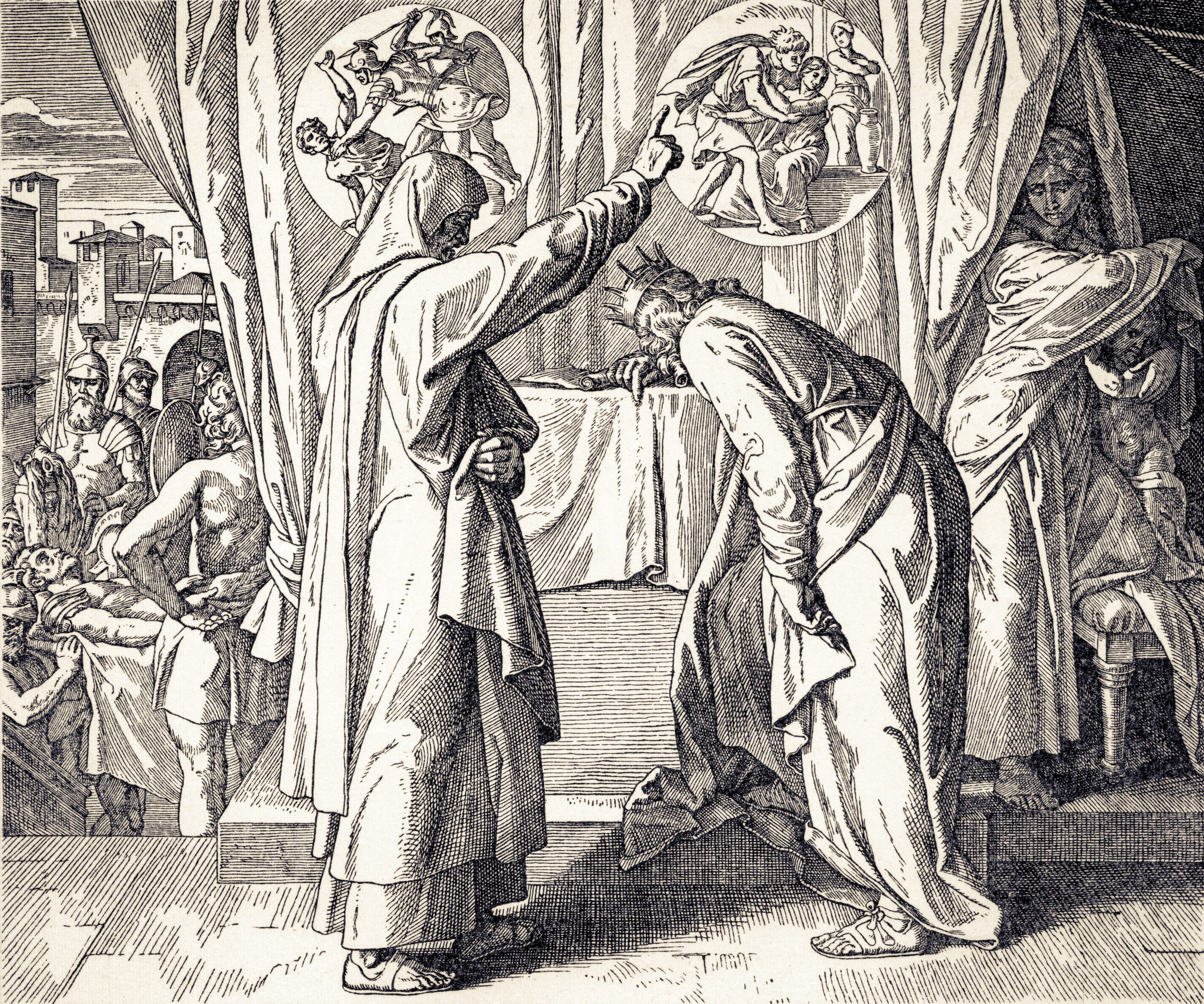
The prophet did not storm into the palace with accusations. He told a story. A story about a rich man and a poor man. A story about a single beloved lamb taken to feed a guest. David listened. His moral clarity was intact. This could not stand! The king’s anger flared. Justice, he declared, must be done. The man deserved to die.
Nathan did not argue.
He did not explain.
He did not soften the moment.
Nathan looked at the king and spoke the words that would shatter an illusion.
“You are the man.”
Nathan didn’t have to fill in the rest. He didn’t have to explain that the king was like the rich man who had taken the sole possession of the poor man’s precious lamb for himself.
The scales fell. David saw himself, for the first time in a long time, not as he wished to be seen, but as he was. He had judged his own actions without realizing it. The verdict he pronounced on the rich man now stood against him.
David collapsed inwardly. The defenses that had held for so long failed all at once. He had sinned against Bathsheba, against Uriah, against his family, against his office, against the people of Israel. But above all, he had sinned against God.
“I have sinned against the Lord,” he said. Nothing more. No explanation. No mitigation. Just truth.
Nathan responded with both mercy and severity. The Lord had put away David’s sin; he would not die, Nathan assured the monarch. But the consequences would be devastating. The child born of the affair would not live. David’s house would know violence and loss. Forgiveness could be granted, but it would not erase the damage.
This is the soil from which Psalm 51 grows.
Psalm 51 is not a theoretical prayer.
David’s prayer is not ceremonial or liturgical.
His poetry is not an exercise or a devotional abstraction.
Psalm 51 is the cry of a man who has been found out.
⸻
This is why our Lenten study will rest on the truthful eloquence of a broken man pleading his case before a merciful God, surprising everyone, and finding grace and peace.
As Alexander McClaren puts it, “there is no confession more honest, no prayer more searching, no mercy more astonishing than Psalm 51.”
That is why we begin here.
⸻
Our journey through Psalm 51 begins with the first verse, which we will take up on Ash Wednesday. Until then, may the Lord richly bless your preparation for the great season of Lent. Find a quiet place in your home. Take a notebook for your own thoughts, or use the book that accompanies the series.
Read the 1 Samuel 11-12 for the original text
One day while browsing in my seminary library, I found the collected sermons of John Donne. After readying a number and since the were edited historically, I turned to his last one. It was on one verse. “Behold the Man!” Starting with Nathan words to David, it was an excellent sermon on the consequences and the weight of sin.
Donne point was behold you and I are the ones whose guilt led to the cross. And like David, we are offered forgiveness at that cross. It is like Nathan confrontation to our wayward souls.
I never forgot it.
A couple of comments worth noting:
(1) According to H.H. Rowley, the Psalter was constructed in such a way that the concepts of personal and corporate were separated by a very opaque line. Some Psalms were written by a Psalmist whose job was composing songs for the community. These likely developed over time, and were likely composed in FIRST PERSON -- reflecting the authorship. So, on the one hand, a personal Psalm could be sung by the congregation as a whole, reflecting their experience as a whole. A personal Psalm could ALSO be sung by the congregation as a whole in solidarity with the individual who wrote it. This is particularly applicable, say to Psalms 142-143, likely written when David hid from Saul in a Cave. I certainly hope that Psalm 51 was not used widely during David's lifetime, but that such a significant work would come to be used corporately makes complete sense. Recall Jesus' recitation of Psalm 22 from the cross, same thing.
(2) Oddly, although the Psalm is attributed to David, it almost certainly was NOT written by David ALONE. Verses 5-6, for example, were probably written by SOLOMON, and the closing about the restoration of Jerusalem makes no sense in the context of David's lifetime. This reinforces the corporate nature of the Psalm itself. The text blends words from multiple authors as if it were written by one author -- because the Israelite tradition did not see a worthwhile distinction between persons in this genre. The attribution to David is almost certainly historical, but more than that, it is liturgical. God's people share a sort of continuity across history, as well as a unity at specific points in history, and this is reflected in the writing of the Psalms.
(3) As I'm sure you noticed, there is a fairly clear distinction in the division of Samuel into two books. In the first, David is portrayed as the mighty hero who can do no wrong. In the second, he is portrayed as a fallen and broken human being who cannot hold his family together no matter how hard he tries -- and he suffers because of it. Brueggeman wrote a fair bit about how Israel tried to balance their view of David as a hero of legend with the reality of the man and his legacy. On that note, there is that strange passage in 2 Samuel 16 where David allows himself to be mocked by Shimei. Although David is portrayed as a failure in that passage -- he has been kicked off the throne by his own son, and now he is being mocked by the family from whom David took the kingship -- he is also repeating the same pattern of behavior for which he was praised in 1 Samuel 24-26, accepting mockery and defeat without retaliating that God might be glorified. There is also the fascinating opening line in 1 Samuel 27: "And David said to himself, 'Now I shall surely die at the hand of Saul.'" Immediately after the two-fold account of his noble deeds in the cave, David seems to have a deathwish. So we see echoes of David's heroism in the book about his humanity, and we see shadows of David's humanity in the book about his heroism.
(4) When it comes to the story of Bathsheba, we are supposed to notice that the damage it does to David's family is NEVER healed. When Absalom takes the throne from David, he brings David's wives and concubines onto the roof and does in public what David did in secret, just as Nathan prophesied, not to mention Amnon's prior abominable misconduct towards Tamar. Although Solomon is an extraordinary ruler, it is as if a hint of his Father's sexual misbehavior "rubbed off" on Solomon, which leads to the division of the nation into North and South. Nothing seems to be able to end the cycle of failure in David's descendants... at least, not at first. This also fits beautifully beside the inclusion of Rahab in Jesus' ancestry. Our Lord is descended from adultery.
Points I always find helpful when approaching this aspect of Scripture. David's story is extraordinary!